

After watching the TV adaptation of The Peripheral in 2022, I was curious about what was next on William Gibson’s Jackpot trilogy. While I hadn’t read the first book, I was hooked by the world-building on screen. Set in North Carolina in 2032, The Peripheral kicks off with Flynne Fisher taking over a shift for her brother, Burton, playing what she believes is a hyper-realistic video game. However, she soon realises that she isn’t playing a game at all; she’s actually in a future version of London in the year 2099. In this reality, data transfer allows people to project their consciousness across time into a ‘peripheral’: a bio-printed, telepresence body.
Flynne learns that her timeline is a past branch of this world, drifting towards what is known as the ‘Jackpot’—a slow-motion apocalypse of pandemics and climate disasters which has wiped out most of humanity. When valuable information is smuggled out through Flynne’s eye, she is pulled into a power struggle amongst dangerous and powerful forces of the future world with competing interests. I found that detail eerily timely, as at the time, Worldcoin was rolling out its eyeball-shaped ‘Orbs’ and scanning irises for digital ID registration. I was disappointed when the show was cancelled after the first season, so I decided to read the sequel, Agency.
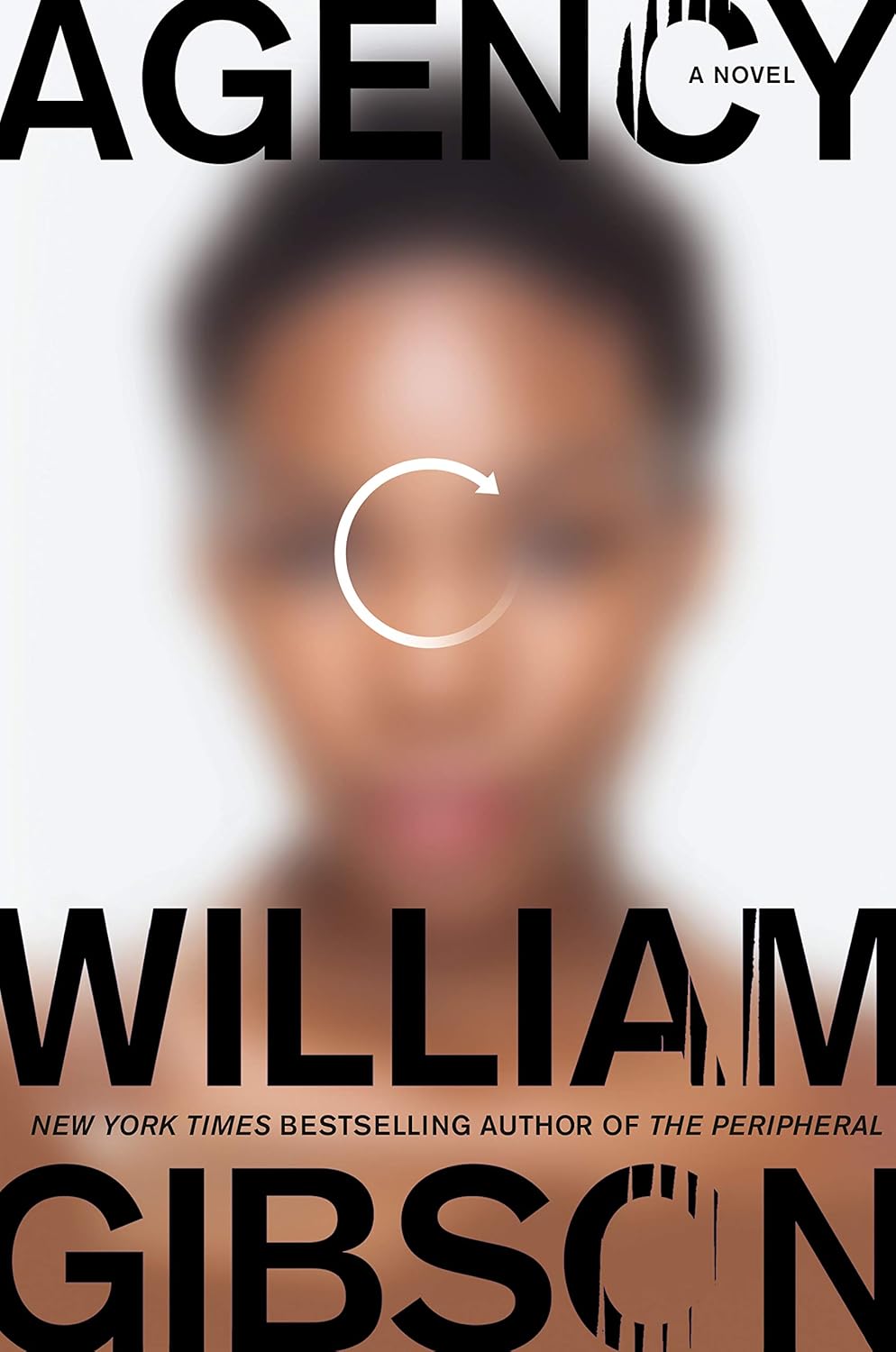
Agency follows Verity Jane, an app-whisperer in an alternative 2017 where Hillary Clinton won the presidency. She is hired to beta-test ‘Eunice’, a mysterious software which turns out to be a hybrid of uploaded consciousness and AI. This unfolds against the backdrop of a political crisis involving events in Qamishli, Syria that poses the danger of nuclear war. My curiosity was piqued, as the threats of unregulated AI and nuclear war are real and present concerns. I also hoped that the subject of uploaded consciousness would be explored in a deeper and more meaningful way; this is what made me stick with it to the end. That said, I have to admit that Agency was not an easy read for me.
We tend to assume their drive to upload to have been about preservation of the individual consciousness of those who could afford it, but the military had a more meritocratic goal. They saw it as cloning complexly specific skill sets. Not personality but expertise.
Agency, William Gibson
There is a large returning cast from The Peripheral: the likes of Wilf, the wealthy and morally grey Lev Zubov, the mysterious Ash, and the formidable Inspector Lowbeer. Even Conner Penske makes an appearance, but while it’s nice to read familiar characters, their roles in this second instalment are not always clear. I found the cast of characters bloated, with the plot buried under mounds of unnecessary detail. There is an exhausting amount of page space dedicated to the logistics of hauling a drone around—a bulky interface that future stub-riders use to ride along for the action. This feels like a lot of heavy lifting for a device that didn’t do much for the story, especially when the characters are supposed to be outrunning a big, bad corporate wolf named Cursion.
Then there’s the dialogue. Apparently, Gibson is known for his clipped, punchy talk, but I just found it jarring. It jumps around and gets tiresomely repetitive, especially when it’s used for exposition dumps. Despite a nuclear war looming, the characters receive the news with a kind of stunned numbness that kills any sense of urgency or stakes. Other readers have complained that, for a book called Agency, our protagonist, Verity, has very little of it. She spends most of her time asking what’s happening and where they’re going, while the action unfolds around her through other people.
One thing that genuinely baffled me was Verity’s total lack of awareness regarding the news. The Qamishli angle is a pivotal plot point, yet she’s oblivious to the point of incredulity. However, the story turned out to be about an AI entity targeting and using a network of resourceful humans to acquire agency for itself. So I did wonder whether Gibson was suggesting that AI will gain power precisely because of the average person’s wilful blindness. That bit of satire, intentional or not, was perhaps the biggest hit in the book for me.
The Peripheral and Agency are the first two instalments of what is intended to be a trilogy, often referred to as the “Jackpot” series. While both books explore the interconnected web of ‘stubs’ and future timelines, the final concluding volume—aptly titled Jackpot—has not yet been released. Fans are still waiting to see how William Gibson will finally tie together the threads of the slow-motion apocalypse and the survival of the various timelines.